FDM
AI in Flight Data Monitoring: What It Can Do, and Where the Red Lines Are
- 2026-07-20
- 5 mins read
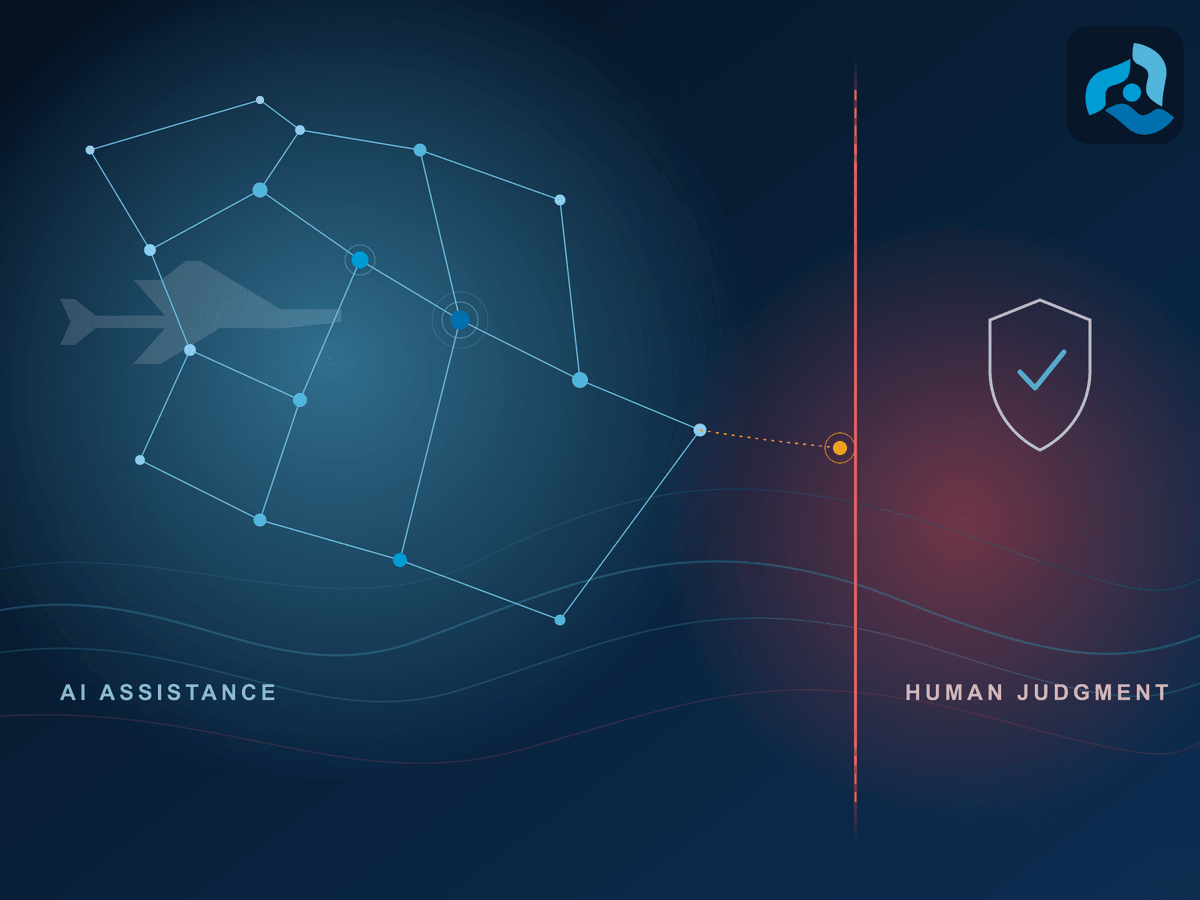
Artificial intelligence has reached every corner of aviation, and flight data monitoring is no exception. Vendors promise AI-powered insights, regulators publish AI roadmaps, and safety managers are asked by their boards why their FDM program isn't "using AI yet." The honest answer is more nuanced than either the enthusiasts or the skeptics would like: AI already delivers real value in flight data monitoring, but only in specific roles — and there are places where it has no business making the call.
In this article we look at what AI is actually doing in FDM programs today, where it genuinely helps safety teams, and where the red lines should be drawn.
Why Flight Data Monitoring Is a Special Case for AI
Aviation and AI are a complex combination regardless of the use case. Flight data monitoring sits inside an airline's safety management system, feeds regulatory compliance, and shapes decisions about training, procedures, and sometimes individual crews. That context sets a higher bar than most industries face: any AI introduced into an FDM workflow must be careful, incremental, and validated against known outcomes before anyone relies on it.
The European Union Aviation Safety Agency has made this explicit. Its Artificial Intelligence Roadmap takes a deliberately human-centric approach, classifying AI applications into three levels — human assistance, human-AI teaming, and advanced automation — with trustworthiness, transparency, and human oversight as foundational requirements. For flight data monitoring, the practical translation is simple: AI belongs at the assistance level. It should make safety teams more productive, not replace their judgment. No FDM tool should give an algorithm the authority to decide what a safety event means or what an airline should do about it.
With that principle in place, the interesting question becomes: where does AI assistance actually pay off?
What AI Is Already Doing in Flight Data Monitoring
The most mature application is anomaly detection. Traditional FDM and FOQA programs are built on exceedance detection: engineers define parameters and thresholds, and the software flags flights that cross them. It works well, but it has a known blind spot — it can only find the problems someone thought to define in advance. NASA-backed research into algorithms such as MKAD and ClusterAD demonstrated years ago that machine learning can surface atypical flights that no exceedance rule would catch, and more recent work with unsupervised deep learning methods — LSTMs, autoencoders, clustering — has extended that capability across full-flight time-series data.
Commercial tools have followed suit, with platforms across the market now advertising machine-learning-based event discovery alongside classic exceedance logic. Beyond safety, flight data feeds AI-driven fuel efficiency and predictive maintenance programs, where pattern recognition over large fleets has produced measurable results.
So the technology is real. The question for a safety manager is not whether AI can process flight data — it clearly can — but which jobs to give it.
Where AI Genuinely Helps FDM Teams
Data validation and anomaly detection
Every FDM analyst knows that flight data is messy. Sensor spikes, dropped frames, mislabeled parameters, and decoding errors are daily realities, and bad data is the fastest way to destroy trust in an FDM program. AI is well suited to flagging suspicious data: a model trained on normal parameter behavior can highlight recordings that look wrong before they generate false events.
The important caveat is that AI should never be the single measure of data quality. It is one detection layer on top of deterministic validation rules, engineering-unit checks, and analyst review — a tool that points a human at the right place faster, not a gatekeeper that silently decides which data is trustworthy.
Statistical analysis and report building
This is where AI delivers the greatest productivity benefit in flight data monitoring today. A large share of an FDM team's time goes into recurring work: quarterly safety reports, fleet trend analysis, comparisons across airports, seasons, and aircraft types. AI assistants are genuinely good at this — querying datasets, aggregating statistics, drafting charts and narrative summaries that an analyst then reviews and finalizes.
But there is a hard precondition: this only works if the underlying data is well structured and clean. An AI asked to summarize trends from fragmented, inconsistent, or poorly decoded flight data will produce fluent, confident nonsense. The airlines getting real value from AI in their flight data analysis are the ones that invested first in a unified, quality-controlled data foundation. Clean data is not a nice-to-have for AI in FDM — it is the entry ticket.
The Red Line: Event Review and Interpretation
Now for the uncomfortable part. The task most central to flight data monitoring — reviewing a flagged event, understanding what happened, and deciding what it means for safety — is precisely the task AI is least suited to own.
Event interpretation requires reconstructing context: what the crew saw, what the weather was doing, what the procedure required, whether the deviation was a symptom of a systemic issue or a one-off. Large language models produce plausible narratives, and that is exactly the danger. Research benchmarking LLMs in safety-critical hazard analysis has found hallucination rates of 15–25% even in fine-tuned, domain-specific models — models confidently citing regulations that don't exist or aircraft limitations that were never published. Additional training reduces the problem; it does not eliminate it. An AI model cannot be trusted as a source of aviation knowledge, no matter how much domain data it has seen.
LLM-based tools can still assist an event review — retrieving similar historical events, pulling relevant sections from documented procedures, drafting a summary for the analyst to correct. But the conclusion of an event review must be human-generated. A hallucinated causal explanation in a safety report isn't an inconvenience; it can misdirect training resources, damage trust with pilots, and in the worst case leave a real hazard unaddressed. This is why current frameworks for LLMs in aviation safety converge on the same architecture: grounded retrieval, verifiable sources, and a human as the final authority.
The same logic applies to decision authority in general. AI should never decide which events are dismissed, which crews are contacted, or which risks are acceptable. Those are accountability decisions, and accountability cannot be delegated to a model.
A Practical Framework for Safety Teams
For airlines evaluating AI in their flight data monitoring program, the division of labor is becoming clear. Give AI the work where it multiplies analyst productivity and errors are catchable: data quality screening, anomaly detection as a complement to exceedance logic, statistical aggregation, and report drafting. Keep humans in charge of everything that requires judgment and carries accountability: event interpretation, risk assessment, and every decision that follows from them.
And before any of it, get the data foundation right. Every successful AI application in FDM — from anomaly detection to automated reporting — depends on structured, validated, well-decoded flight data. Airlines that skip this step don't get AI-powered insight; they get automated confusion.
Used this way, AI doesn't diminish the role of the FDM analyst. It removes the repetitive work that keeps skilled safety professionals from doing what they are actually there for: understanding what the data says about the operation, and acting on it.
Fliant helps airlines build modern, automated flight data monitoring programs on a clean, AI-ready data foundation. If you're thinking about where AI fits in your FDM program, talk to us.